
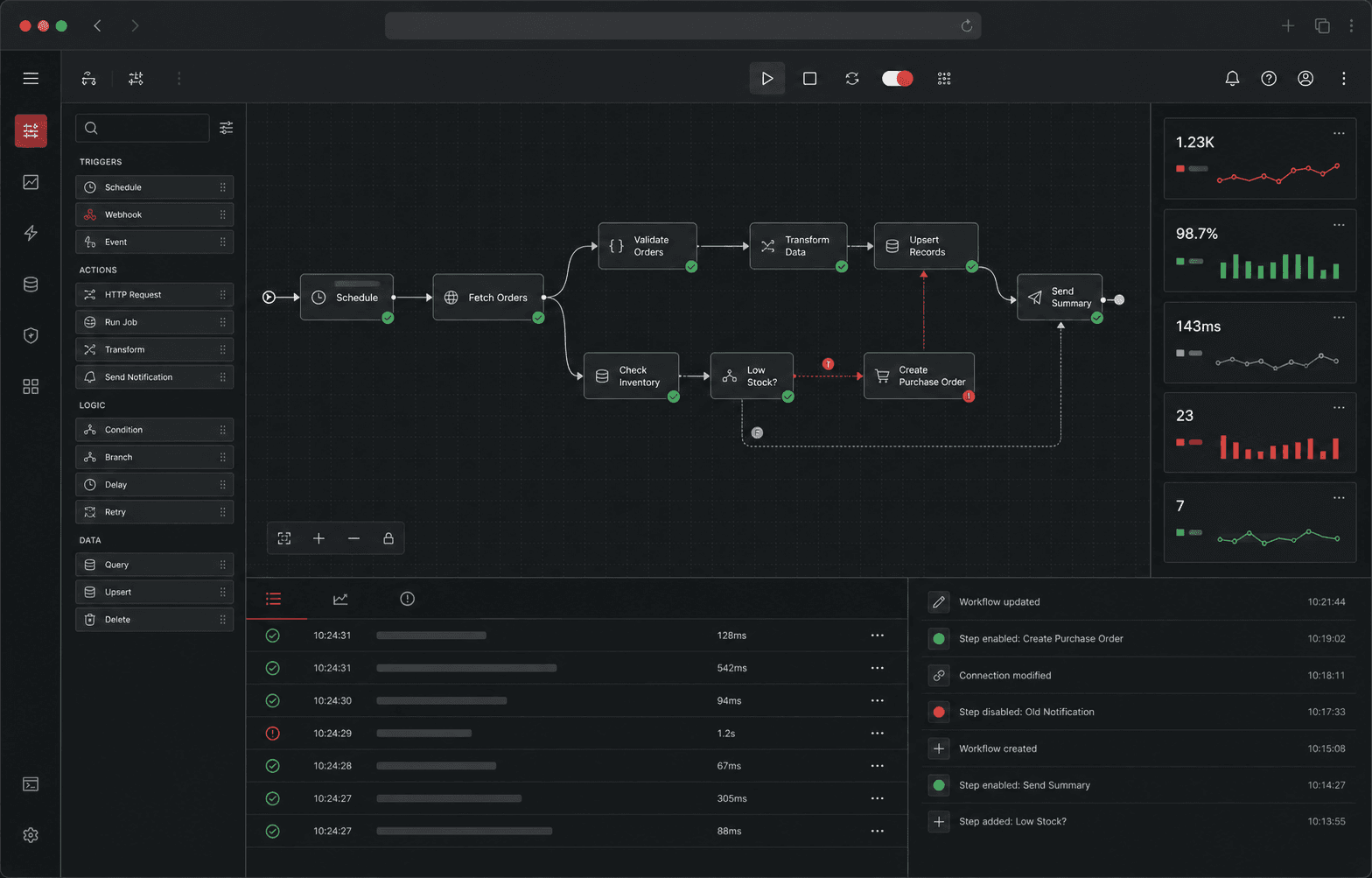
Overview
A deliberate approach to a better interface.
- Problem
- Automation is valuable only when teams can trust it. Raw logs and fragmented status messages make important operational signals easy to miss.
- Solution
- Designed an observability-focused interface that prioritizes status, exception handling, and the next useful action.
- My role
- Product thinking, UI system design, frontend implementation, and workflow integration.
- Timeline
- 2 weeks
- Team
- Independent concept
- Tech stack
- Next.js, Firebase, n8n, Framer Motion
Performance and quality snapshot
Targets established for a fast, accessible delivery
- Uptime
- 99.9%
- INP
- <150ms
- Accessibility
- 100
- Core flows
- 3
service target
interaction target
audit target
visible at a glance
Design process
- Started with the decisions an operator needs to make in under a minute.
- Used visual hierarchy to distinguish healthy work from items that need attention.
- Balanced information density with a clear, predictable interaction model.
Architecture
- Composable dashboard primitives allow new workflow types without a visual rewrite.
- Event-oriented data states keep loading, success, and failure conditions explicit.
- The interface is designed to work with Firebase-backed data and n8n workflows.
Performance optimization
- Separated data-heavy views to prevent monitoring detail from delaying the first route.
- Used lightweight motion only to reinforce state changes and hierarchy.
- Designed stable dashboard regions to minimize cumulative layout shift.
Accessibility
- Status changes have text labels as well as visual color treatment.
- Interactive controls have descriptive labels and predictable tab order.
- Dense metrics maintain readable contrast in both themes.
SEO
- Semantic page structure gives public project documentation a strong technical baseline.
- Metadata is scoped per route for clear sharing and indexing.
- Content explains the business value of automation, not just the stack.
Challenges
- Presenting real-time complexity without turning the product into an intimidating control room.
- Making status information understandable at a glance and accessible in detail.
Results
- Uptime: 99.9% (service target)
- INP: <150ms (interaction target)
- Accessibility: 100 (audit target)
- Core flows: 3 (visible at a glance)
Have a similar product challenge?
Let's turn the requirements into a resilient, high-performing interface.